
Batch Affine Ladders with Eisenstein Recoding
Ironwood, the shielded pool introduced by the NU6.3 upgrade, keeps Orchard's underlying cryptography, and with it Orchard's scanning workload. Wallets discover incoming payments by trial decryption, and the expensive step of each trial is Diffie–Hellman key agreement:

Here  is an ephemeral public key that arrives in a shielded transaction and varies for every output.
  is the wallet's incoming viewing key, and it does not change. A wallet might use the same to multiply millions of unrelated points over a period of years.
That is a strange scalar-multiplication workload. Textbook treatments of elliptic-curve multiplication ask how quickly we can compute  for one arbitrary scalar and one arbitrary point. Scanning instead hands us a large batch

The curve itself is also unusually helpful. It is Pallas,

over a roughly 255-bit prime field. It has  -invariant zero and a cheap order-three endomorphism
  for a (nontrivial) cube root of unity
  and a known constant
  . That endomorphism is what makes GLV scalar multiplication possible.
But once we are using GLV, can we exploit the fact that scanning wants many multiplications by the same scalar at once?
The answer is yes, by moving much more of the computation into affine coordinates and sharing inversions throughout the batch rather than only at the end. Instead of the traditional GLV recoding, we use Eisenstein integer recoding to reduce the number of point additions in a way that is also conducive to the batch inversions.
In our end-to-end batch trial-decryption benchmarks, our approach beats the current implementation by 16–20% at batch sizes from 64 through 200 outputs.
Scalar Multiplications
Ignore the batch setting for the moment and consider just a single for our  -bit scalar
  . The classic algorithm is double-and-add: write in binary (most significant bit first) and process the bits left to right. Every bit costs a doubling of a running accumulator, and when the bit is set it also costs an addition of
  .
.
We'll visualize each bit position as a single column of work. In this case, about half of the bits will be set for a random scalar, and so this naive scalar multiplication algorithm costs  doublings and roughly
  additions.
Unfortunately, the affine point formulas require a field inversion (by far the most expensive field operation) and an inversion or two per column is not workable. The standard solution is projective (Jacobian) coordinates: represent the point  as
as  with
with  and
and  , and rewrite the formulas to multiply denominators into
  rather than dividing by them.
This approach avoids any inversions within the multiplication loop itself, which we'll refer to as the ladder. Each column contributes only a handful of field operations.
Of course, the result is not usable in this projective form, since it is not a unique representation. In the case of key agreement the KDF that consumes the shared secret is defined over its affine encoding, so both sides must arrive at identical bytes. Thus, when the ladder is complete we must convert the result back to affine coordinates, requiring one inversion after all.
For a single multiplication this is unavoidable. But wallet scanning is never a single multiplication: when  trial decryptions finish together, we hold projective results that all need an inversion at the same moment. Simultaneous inversions can be merged with Montgomery's trick, which inverts field elements for the price of one inversion and about
  multiplications. In fact, the
 pasta_curves code we inherit does just this, encouraging its API users to batch trial decryptions so that the code can internally apply this amortization.
But the technique has larger implications. It is one instance of a general pattern: whenever every multiplication in a batch needs an inversion at the same moment, one shared inversion serves them all. As we'll see, because is the same in each scalar multiplication during trial decryption there are opportunities within the ladder to do the same thing.
Non-adjacent Form (NAF)
Given the use of projective coordinates, improving performance within the ladder is a matter of reducing the number of group operations themselves. We can reduce the number of additions by observing that a binary  digit set for the scalar is not required: on an elliptic curve negation is free, so subtracting costs the same as adding it, and so can be recoded over the signed digits
  .
.
The non-adjacent form (NAF) does this canonically. Process from the low end:
- If is even, emit
 and halve .
 - If is odd, emit the digit
 chosen from
  , then subtract
  and halve .
 - Repeat until
 .
.
The choice of digit at odd values forces  to be divisible by
  , so every nonzero digit is followed by a zero. For a random -bit scalar the density of nonzero digits drops from
  to
to  , and the addition count falls from about to about
  .
.
The same idea extends to larger digits. We can't cheaply add or subtract  or
or  , but if we precompute a small table of odd multiples of we can subtract a larger residue and force a longer run of zeros.
The width- NAF uses the digits
  along with , and the algorithm generalizes:
- If is even, emit and halve .
- If is odd, emit the digit
 chosen from
  , then subtract and halve .
 - Repeat until .
Since is divisible by  , the next
  steps necessarily emit : every nonzero digit is followed by at least zeros, and on average only
  of the digits are nonzero. Similarly, for a
  -bit scalar, the additions in the main loop drop from roughly
  with the plain NAF to roughly
  .
.
Of course, -NAF requires us to precompute the table in the first place. In the case of key agreement the table is different for each and has to be computed online, and therefore its costs for scalar multiplication are counted alongside the ladder.
The digit set includes  nonzero values, but since negation is free the table only stores
  positive odd multiples of . This costs group operations to compute, and so together with the ladder the cost is

point additions for a length- scalar multiplication of with -NAF. (The number of doublings remains  , regardless of the width .)
Graphed above for a -bit scalar we can see that the optimum is  , but for the smaller values of we'll discuss in this post the optimal varies between and
  depending on second-order effects.
GLV
Pallas has -invariant zero, and curves of that shape have an unusually large automorphism group. Concretely, the map

is a group endomorphism, where is a fixed primitive cube root of unity in the base field. It costs one field multiplication. On a prime-order group every endomorphism acts as multiplication by some scalar, and this one acts as  , where is a primitive cube root of unity in the scalar field.
GLV decomposition uses this endomorphism to reduce the number of doublings during the ladder by half. Given , we find a pair  with
with

with  . This splits our scalar in half, and we can rewrite as

where each term could (naively) be evaluated with a separate -NAF multiplication of half size. The two digit strings can be run through a single shared doubling ladder, consuming roughly doublings together. Despite one -NAF being over and the other over  , the two are related by the cheap endomorphism, so they share table construction costs as well.
This arrangement, with  , is exactly how the original
 pasta_curves implementation uses GLV and -NAF together. The shared table cost is only group operations, which is great, but the ladder is suboptimal:
The two digit strings are recoded independently, and so while they share doublings, columns pay an addition for each stream that happens to fire. This is an expected  additions per column, or
  total ladder additions on average in the case of Pallas.
There are two clear improvements, and they are independent. The first involves augmenting the table with all mixed sums  so that any column where both streams fire (call it a "coincidence") performs a single combined addition instead of two. The second is to recode the halves jointly as the pair such that fewer columns fire in the first place.
Joint Integer NAF
The naive approach of tacking on coincidences in the table simply doesn't work. The coincidences happen rarely during the ladder (roughly  of all columns) but because accounting for every possible requires
  points to be precomputed (with
  group operations), we pay heavily for little in return.
The second of these optimizations is better, and we'll refer to it as a joint integer NAF. We start with the decomposition from GLV, and then recode it as follows:
- If
 and
and  are both even, emit and halve both.
 - Otherwise, emit the digit
 , where each
  is the representative of
  in
in  ; subtract, and halve both.
 - Repeat until
 .
.
This is a similar procedure to the traditional -NAF, adjusted for paired digits. There are  digit pairs in total, one for each residue class of
  in which at least one half is odd (
 ).
).
However, there's an interesting quirk about the table required by this recoder: it requires  points. Such a table serves
  digits when accounting for free negations, which is more than needed to cover the congruence classes. This happens because the set of digits produced by the recoder are not closed under negation (
 is not produced), and so
  of the points in the table are partly wasted.
This is easily repaired, though, by special casing these digits. More rigorously, the recoder's odd rule becomes:
Otherwise, emit a digit pair
, chosen as follows. The
- If the current class is canonical, each
- If not,
Subtract and halve both.
This recoder requires a table of  stored points built from
  group operations. That is also a painful table generation cost, but it comes with an incredible
  addition average during the ladder. This is partly because the recoding has made the emitted NAF digits more sparse, but also because it has absorbed the cost of coincidences with the table.
Overall, the joint integer NAF recoding costs  additions per multiplication, which is more expensive than the split -NAF already implemented in
 pasta_curves. But there is a way to avoid the expensive table generation of joint integer -NAF while achieving the same number of group additions during the ladder. In fact, it substantially beats the existing split -NAF unlike the naive approaches previously discussed.
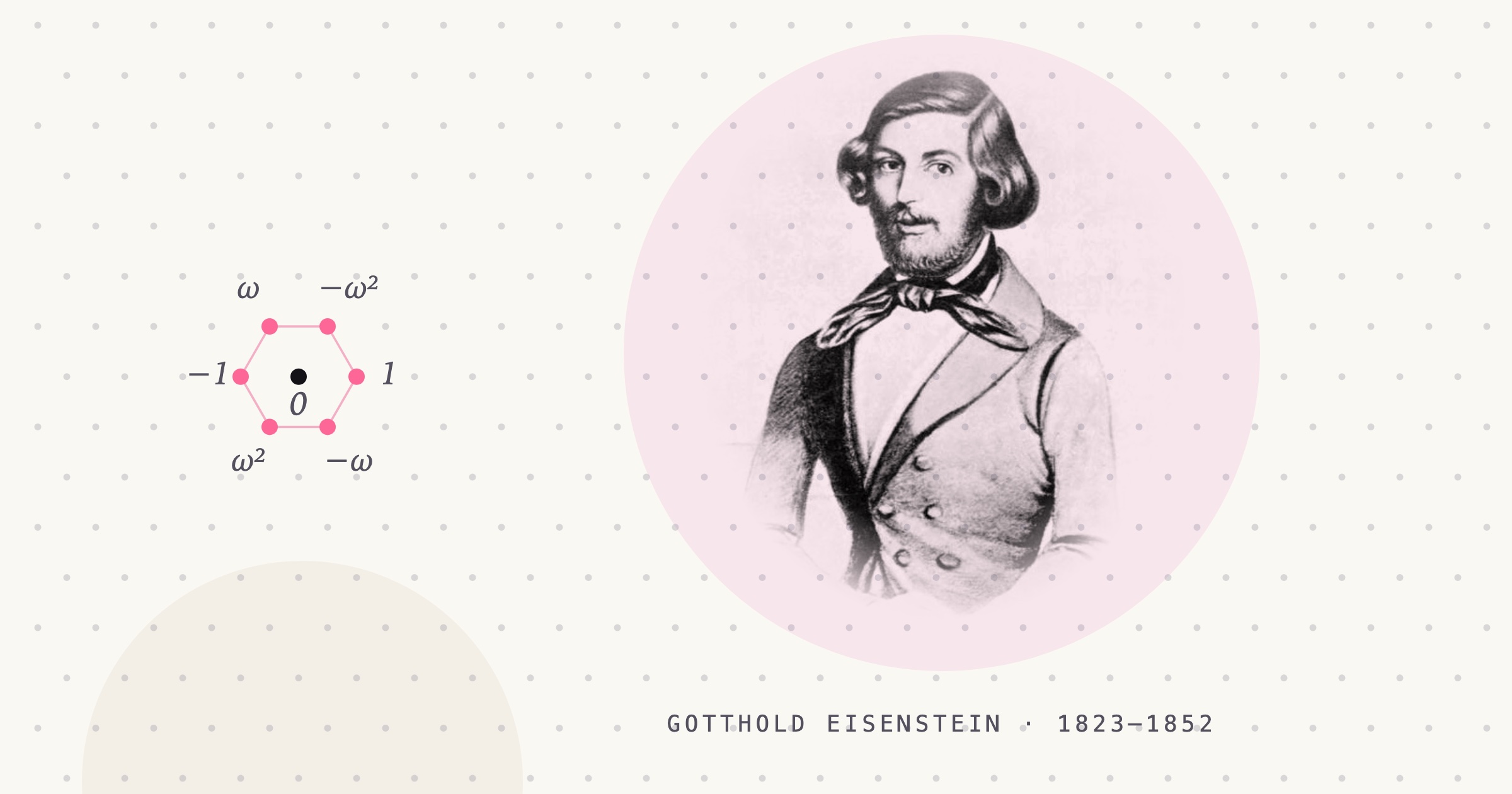
Eisenstein integers
Observe that the pair , produced by the GLV decomposition, is really an element of the ring

in which  is a cube root of unity and the algebraic stand-in for . This much is unsurprising, since are small solutions of
  by construction, and satisfies the same equation
  in the scalar field
  .
.
This is the ring of Eisenstein integers. Elements in this ring have the same algebraic properties needed to run the -NAF recoding on them. There is a real sense in which some are "even" or "odd" because  is prime in the ring (as
  is irreducible
  ), and it is the same sense in which we previously described their NAF decomposition: they are even iff their components are both even. Halving is similarly exact.
The only question is how to draw the digits. In the ordinary joint integer -NAF they are drawn coordinate-wise, and each component emits its own small residue modulo (the signed odd residue when  is odd, or a small even one when is even) so as to ensure the remainder
  is divisible by . But that's not the only way to satisfy the requirement; in the ring, any digit
  makes
makes  divisible by and forces the same minimum run of zeros, but the residual
  , and hence the rest of the string, still depends on which representative of the class was chosen as the digit.
Thus, the coordinate-wise digit scheme is one of a set of possible recoders that map each of the 48 odd residue classes modulo to an exact ring element congruent to it, since each digit pair it produces is an element of that ring.
We can now start to see the reason why the naive joint integer NAF required an expensive table. In the diagram above the digits it produces are shown in green, and they appear on rows where other digits are within the orbits of the unit actions in the ring. These actions are the six curve automorphisms we have access to. Many of the digits produced by these unit actions over their unique shared representative (an Eisenstein digit) cover congruence classes that other digits actually handle.
Given  automorphisms, we'd hope to be able to find representatives with distinct orbits to exactly cover the congruence classes. Indeed, here is an example:
The eight representatives can be extracted using a small number of group operations, using the following algorithm:
φP   ← φ(P)                      //  ωP               1 mult
d1   ← P − φP                    // (1−ω)P            add 1
b    ← d1 − φ(d1)                // −3ωP              add 2, 1 mult
m3   ← φ(φ(b))                   // −3P               φ²
r3   ← −φ(b)                     //  3ω²P             1 mult, shared with φ²
t3a  ← m3 + φP                   // (−3+ω)P           add 3
t3b  ← φP − m3                   // (3+ω)P            add 4
t4a  ← φP + r3                   // (−3−2ω)P          add 5
t4b  ← φP − r3                   // (3+4ω)P           add 6
t19  ← t4b + φP                  // (3+5ω)P           add 7

T[0..7] ← P, d1, φ(t4a), −φ(t3b), −m3, −t3a, φ²(t4b), φ²(t19)
And because this algorithm's table can be generated so efficiently, we obtain the most efficient variable base scalar multiplication known for these curves:
| Split wNAF-4 (baseline) | wNAF-4 + coincidences | Joint integer NAF | Joint Eisenstein NAF | |
|---|---|---|---|---|
| Ladder additions per mult, A | ~51.2 | ~46.0 | ~38.4 | ~38.4 |
| Max adds | 59 | 57 | 43 | 43 |
| Doublings | ~124.9 | ~124.9 | ~124.9 | ~124.9 |
| Table-build group ops, B | 4 adds | 36 adds | 23 adds | 7 adds (+8 rotation mults) |
| Field elements stored | 8 x + 8 y = 16 | 16 + (32 x + 32 y) = 80 | 24 x + 24 y = 48 | 24 x + 8 y = 32 |
| Table bytes | 512 B | ~2.5 KiB | 1.5 KiB | 1 KiB |
| B + A per mult (table not reused) | 55.2 | 82.0 | 61.4 | 45.4 |
| Saving (group ops) | — | +49% | +11% | −18% |
Full Batch Ladder
Everything so far optimizes one multiplication. Recall that some expensive inversions can be shared when they take place simultaneously in different ladders. Because every ladder in our batch key agreement involves the same scalar (and thus the same schedule) every column is identical in each ladder.
This is even more pronounced in the Eisenstein recoding setting, where it is now beneficial to combine each GLV half into a single digit stream and ladder. The result is that a smaller size batch (in our experience, one just of size  ) is sufficient to use affine point addition formulas (and thus shared inversions) throughout the ladder.
| column | batched affine | Jacobian |
|---|---|---|
| doubling | about  |  |
| addition | about  |  |
This works even though batch affine doubling is roughly break-even against Jacobian. Batched affine addition is much cheaper. The technique's cost effectiveness is concentrated in the addition columns, which is why the Eisenstein recoding is so helpful: it minimizes additions per column, and it guarantees at most one addition per column. This is the exact dimension the batch affine ladder prefers to optimize for.
Once every active column has the form

we can compute it with a fused formula due to Eisenträger, Lauter, and Montgomery, developed precisely to speed up elliptic-curve scalar multiplication in affine coordinates. Reordering  as
as  avoids the doubling and saves a squaring, and the formula never computes the intermediate point's
  -coordinate, saving a multiplication: approximately
  per active column compared with a separate affine doubling and addition.
Batch key agreement: so is it actually faster?
Yes. We benchmarked it, end to end, as batch trial decryption against the current GLV implementation. The full change comes in between 16 and 20% faster at batch sizes from 64 through 200 outputs, and between 8.8 and 20.5% faster across all tested sizes from 10 through 200.
The surprising result of this optimization is perhaps the Eisenstein recoding, which appears to be a novel technique for optimizing GLV over -invariant curves like the Pasta curves, and like secp256k1. Indeed, it appears to produce the most efficient variable base scalar multiplication in the literature for these curves.
Acknowledgements
We thank Ariel Gabizon for helpful feedback and questions.