

Quantum Unlinkability for Zcash Swaps
Zcash’s shielded transactions are private against future quantum adversaries in many ordinary cases, which is crucial given harvest now, decrypt later attacks. But until Tachyon ships, there is a glaring hole: a single published shielded address lets a quantum attacker link every payment that address’s key has ever received. The most concerning case is swaps through NEAR Intents, where the user’s shielded address is posted on NEAR’s public chain.
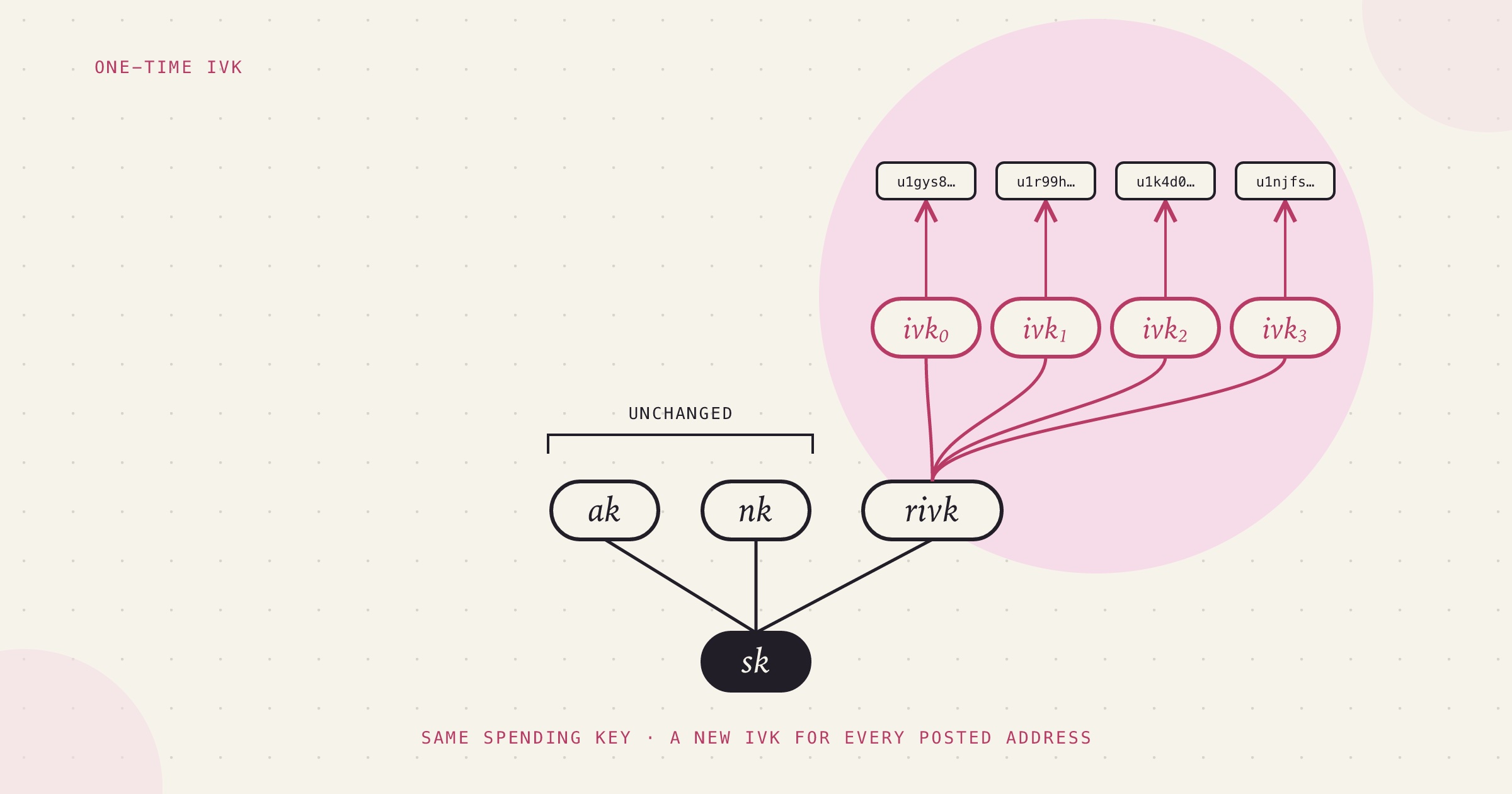
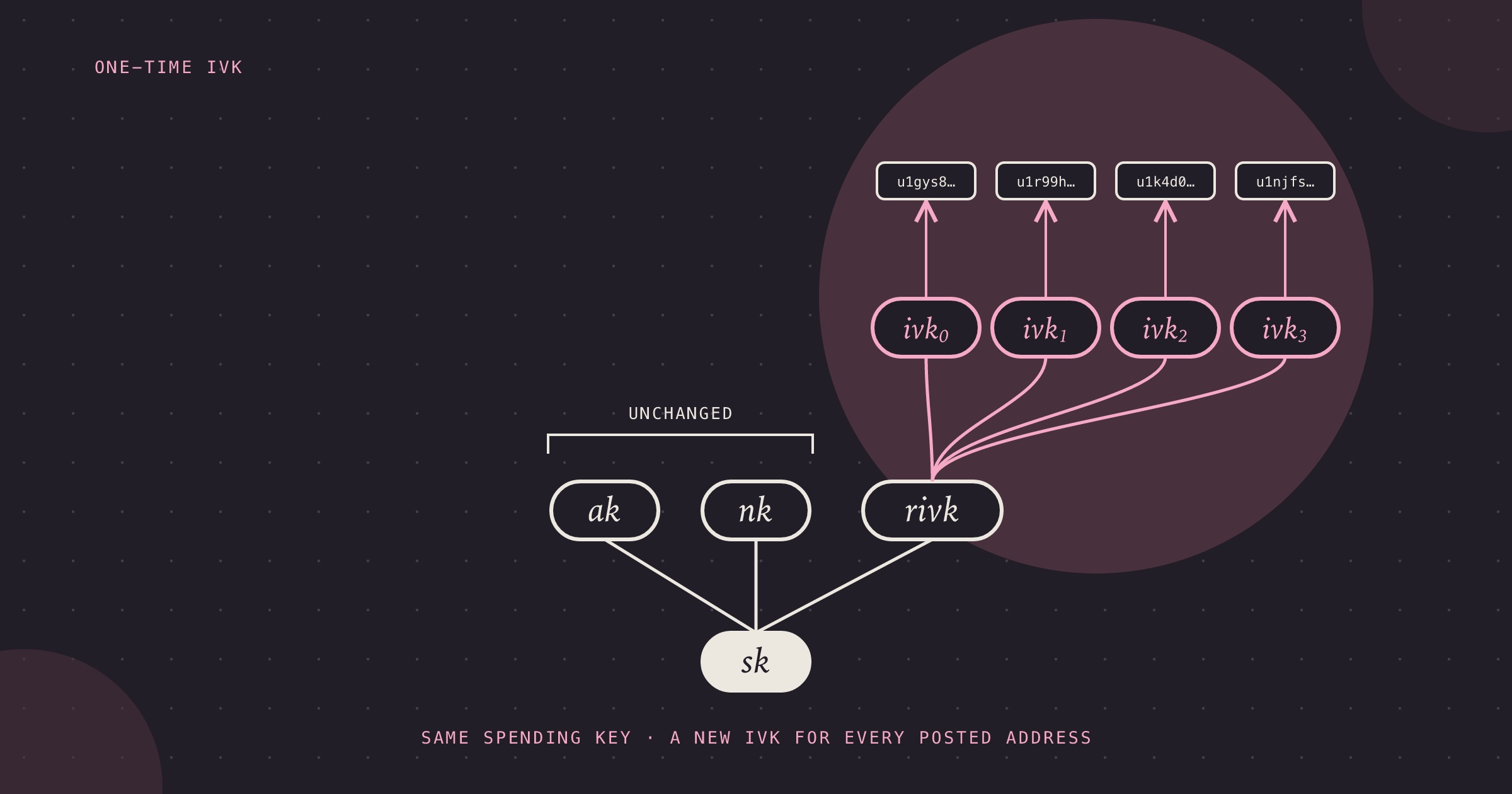
We set out to build a fix that wallets can deploy today. It derives a separate incoming viewing key, or  , for each address that has to be published, with the account’s spending key untouched, so an attacker who recovers one address’s key learns only the payments made to that address. We call it a one-time
 .
Each extra key is another key to scan with when restoring a wallet from seed, so a naive recovery would get slower with every swap. To keep it practical we use private information retrieval (PIR), the same technique behind our lookups for Zcash's coinholder voting.
How a Payment Finds You
Every Zcash shielded account has one secret key behind all of its addresses, the incoming viewing key . An address encodes a short diversifier  and an elliptic curve point
 . The wallet hashes to a base point
 and computes

Alice's wallet can produce as many addresses as it likes by changing . Each gets its own and , and every one of them is computed from the same . Ordinarily, she would give an address to Bob directly when she wants to be paid rather than publishing it anywhere. Even if it were to leak, the address would not reveal , since recovering it from and is the discrete log problem, which is infeasible for a classical computer.
When Bob pays Alice, his wallet decodes her address, recovers from , and uses it with in a Diffie–Hellman key exchange. That gives Bob a secret that Alice can also compute, using . His wallet encrypts the payment under that secret and posts it to the chain, and Alice's wallet decrypts it.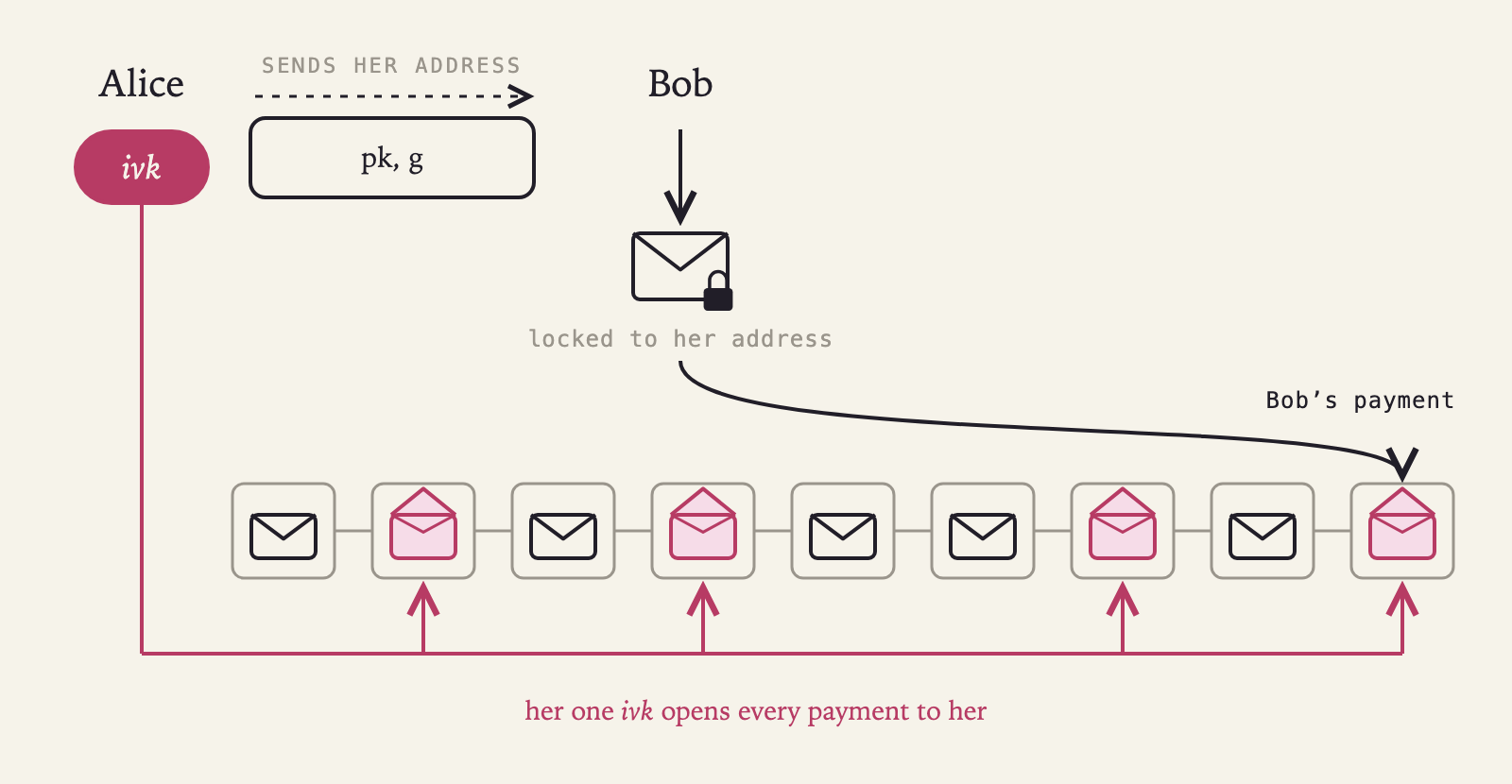
That same opens every payment anyone has ever sent to any of Alice's addresses. Whoever holds it sees the value and memo of each one, and sees that they all belong together.
Quantum Adversaries
Keeping Alice’s payments private comes down to keeping her secret. Her wallet never shares it, and nobody can compute it from one of her addresses with a classical computer, but a sufficiently powerful quantum computer running Shor’s algorithm could recover Alice's from the  and
 decoded from any one of her addresses.
Even then, a quantum computer can only do this with one of Alice’s addresses in hand, because the chain itself never contains or . Each payment is locked to her address without revealing it, which is a large part of why, as Sean Bowe explains in Zcash and Quantum Computers, Zcash’s shielded transactions already keep their privacy against quantum computers in many common cases.
Alice’s exposure therefore depends on where her addresses end up. An address she sends to a payer can leak, but one posted somewhere public and permanent is easy to find, and it will still be there whenever a powerful enough quantum computer exists. From that one address, an attacker could recover Alice's and link together every payment her account has ever received.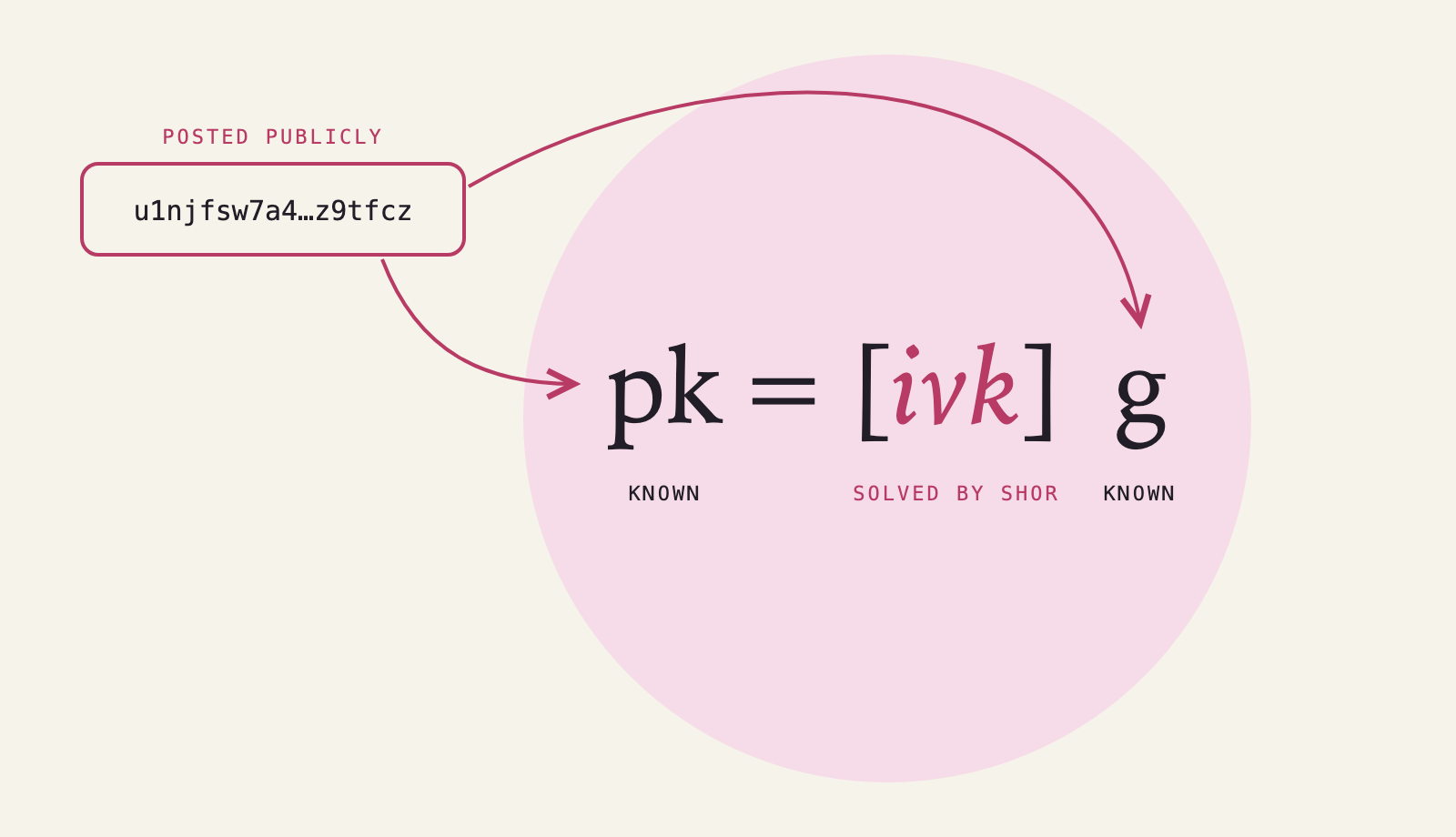
How Addresses Become Permanently Exposed
Say Alice wants to pay Bob, who wants USDC on Ethereum. Alice only holds ZEC, so she swaps through NEAR Intents to pay Bob.
Alice's wallet deposits ZEC to a NEAR deposit address on the Zcash chain. The swap quote Alice's wallet generated injects a refundTo address, which is one of Alice's shielded addresses. If the swap fails, or some ZEC goes unused, NEAR sends it back to the refundTo address. That address is written to NEAR's public chain as soon as the deposit registers, whether or not a refund ever happens.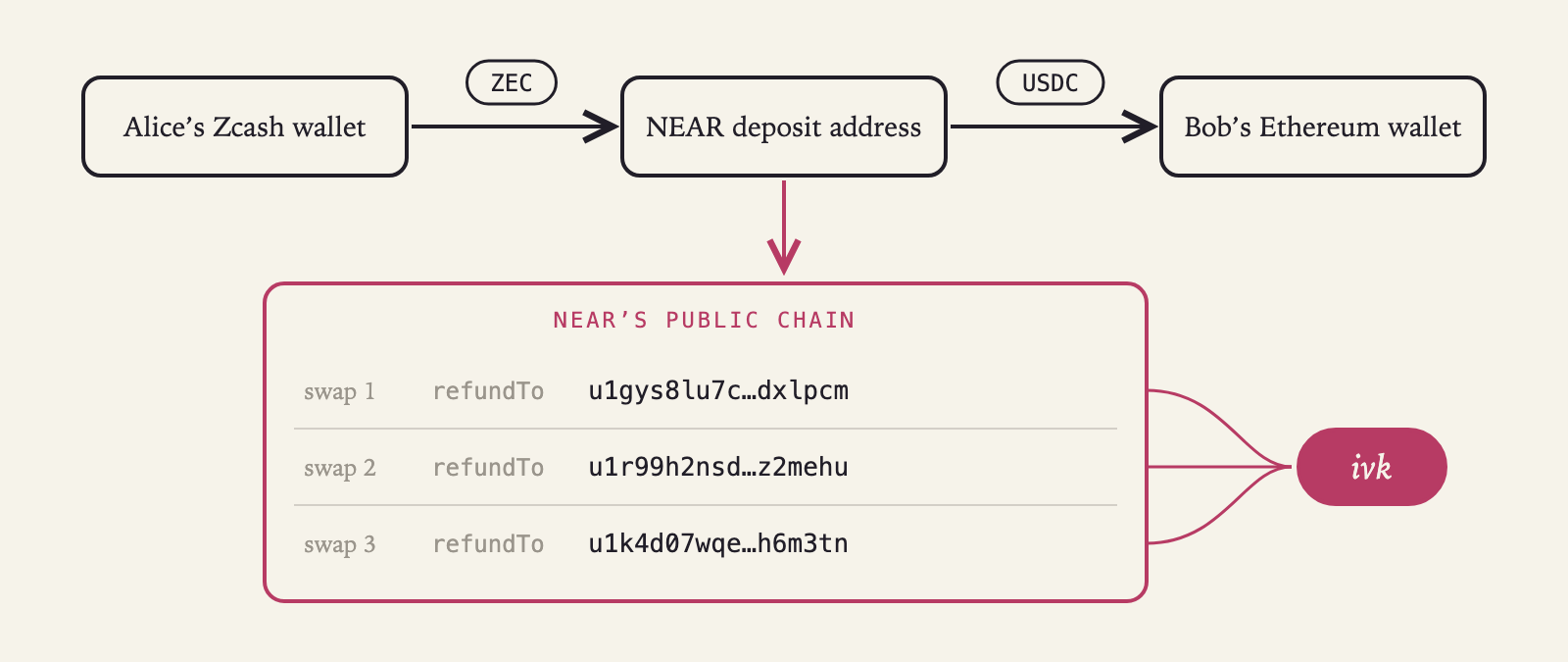
Every swap out of ZEC to another chain posts a new refund address. Similarly, swaps into ZEC from another chain post the shielded address as the recipient. The addresses all look different, but they are diversified addresses of one account. A quantum computer only has to break one of them to get the behind all of them, and with it every payment the account ever received.
A Naive Fix
The naive approach is to generate a new account for every swap. Each account has its own , so even if a posted address is broken, it exposes only that one account's payments.
This works, but it is impractical for everyday use since Alice's ZEC ends up split across many accounts. Software wallets can work around this, but hardware wallets such as Keystone and Ledger make this not feasible.
Keystone's Zcash support only allows signing from account index 0, which leaves funds in all other accounts inaccessible. Ledger has access to every account index, but can only spend from one account per transaction. This would mean going through the manual transaction review process / approval multiple times for a single payment, which wasn't an acceptable UX to us.
We needed to find a way for each swap to still have its own , while keeping everything spendable from a single key.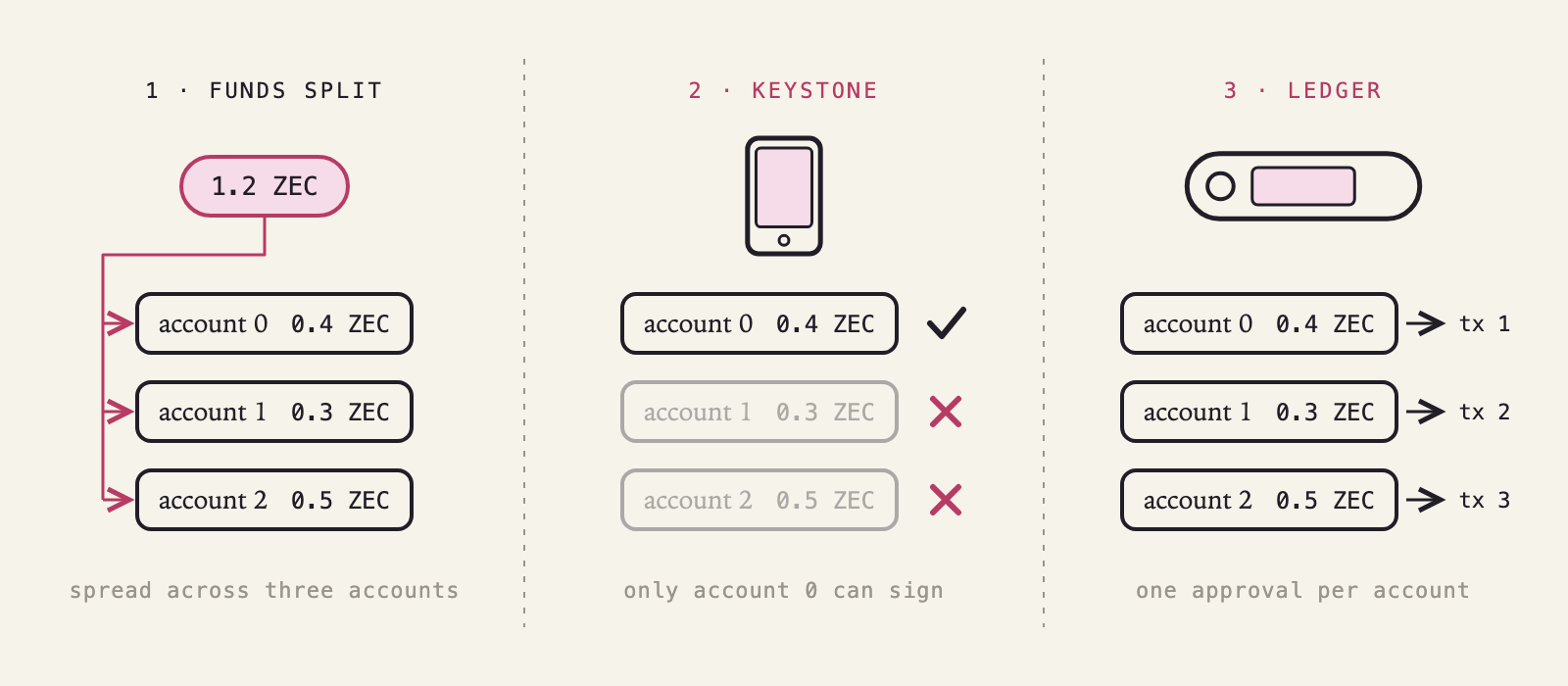
The One-Time ivk
To give each swap its own without splitting the wallet, we needed to change how is generated while leaving everything that controls spending untouched. Zcash derives each of an account’s keys from the spending key  , so it helps to look at that derivation first. The spending key derives three secrets. The first,
 , signs spends, and its public half is
 . The second,
 , derives the nullifiers that mark notes as spent, and the third,
 , randomizes so that it reveals nothing about or . Together , and form the full viewing key, and is a commitment to and .
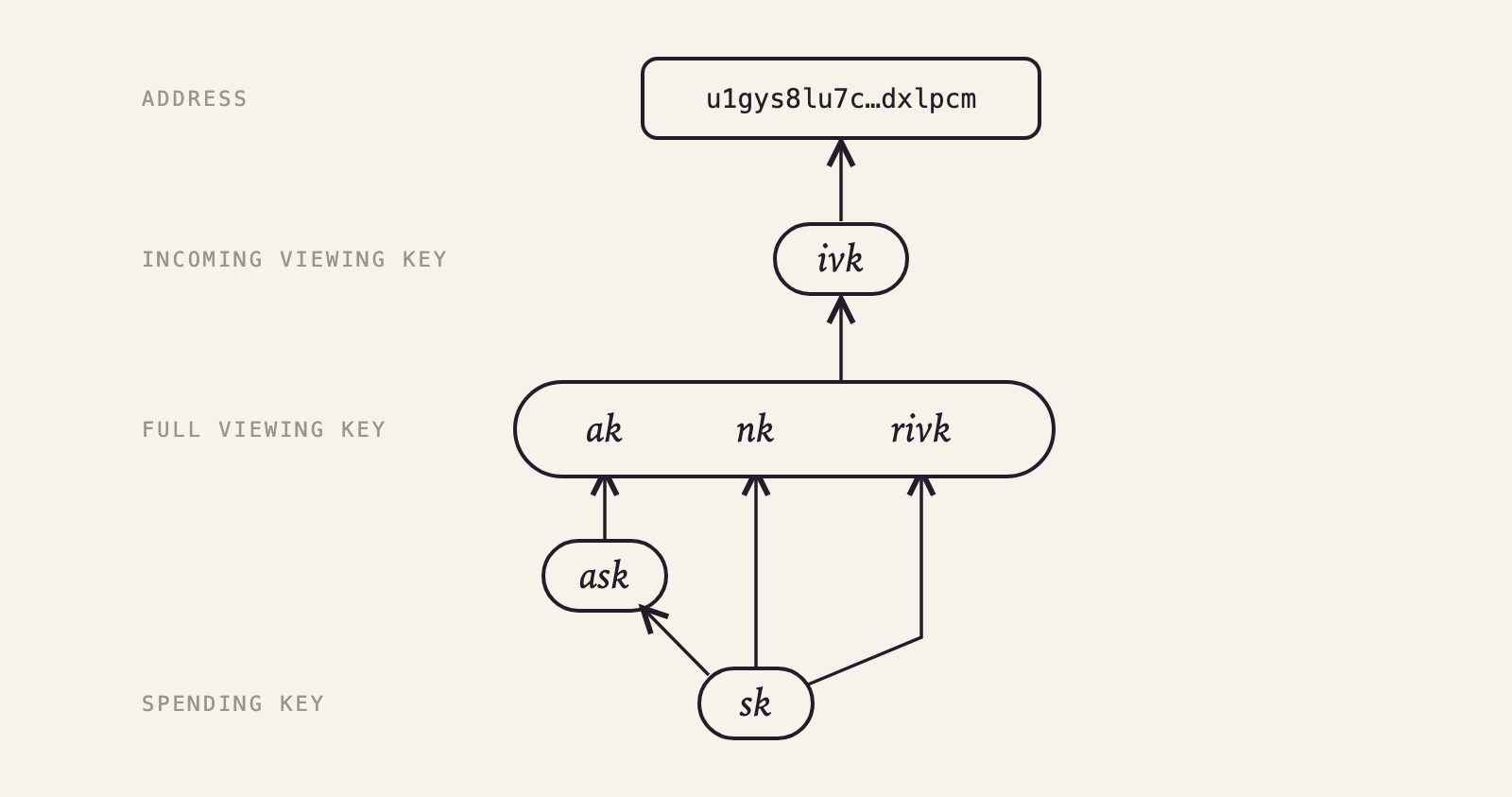
What if we deterministically derived a new for each swap instead of using the same randomness every time?

 is the keyed hash Zcash already uses to derive keys. ZIP 32 uses this same construction to give each account a separate set of internal keys for change, keeping and and deriving a new from the old one. Ours differs in two ways. It uses its own domain byte, so swap keys can never collide with internal keys, and it appends the purpose and an index, so one account can have as many swap keys as it needs instead of a single internal key. The swap's is then built the usual way, from the same and with the new , and the address Alice posts is built on that .
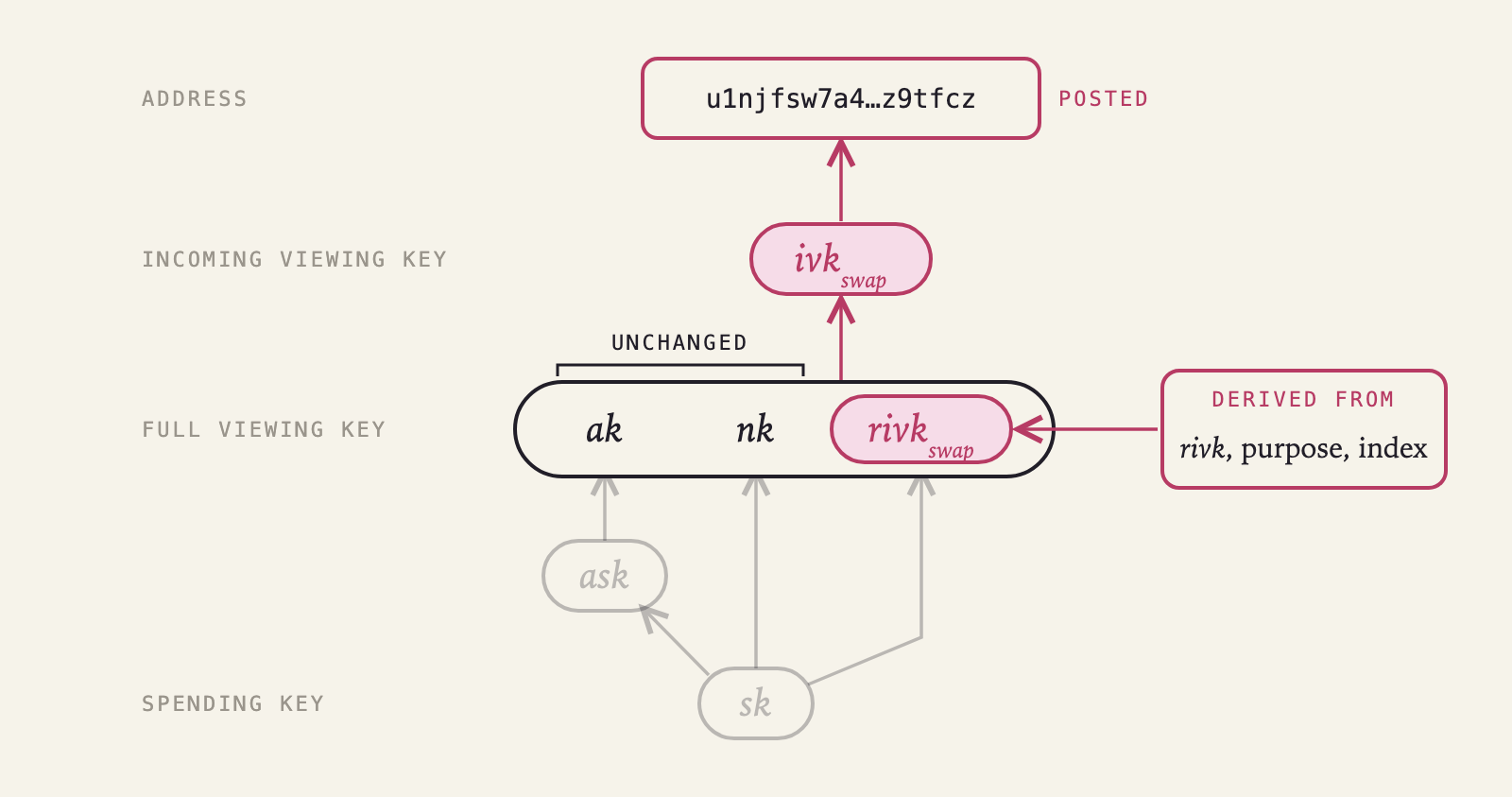
Because and remain static, spending works the same as before. The account's spending key spends funds received at a swap address directly, and the wallet stays on one account.
Breaking a posted address now gives a quantum attacker that swap's and the payments to that one address. Each swap's looks like an unrelated account's, and tying it back to the account means inverting a hash based derivation, which stays out of reach even for a quantum computer.
The One-Time ivk In Use
Now take Alice's payment to Bob again, this time with the one-time . When she deposits, her wallet takes the next refund index (let's say index 0), derives a fresh swap key from it, and posts the refund address built on that key, so the address on NEAR's public chain has its own .
The deposit transaction Alice makes on the Zcash chain also leaves a note to herself in its change output, which is a memo containing the refund index used to derive that swap’s . The memo is encrypted to her own internal viewing key, so only she can read it, and is how a restored wallet will find this refund later. Recovery will soon be explained, just know that Alice leaves this memo behind to herself so she knows how the for this swap was derived.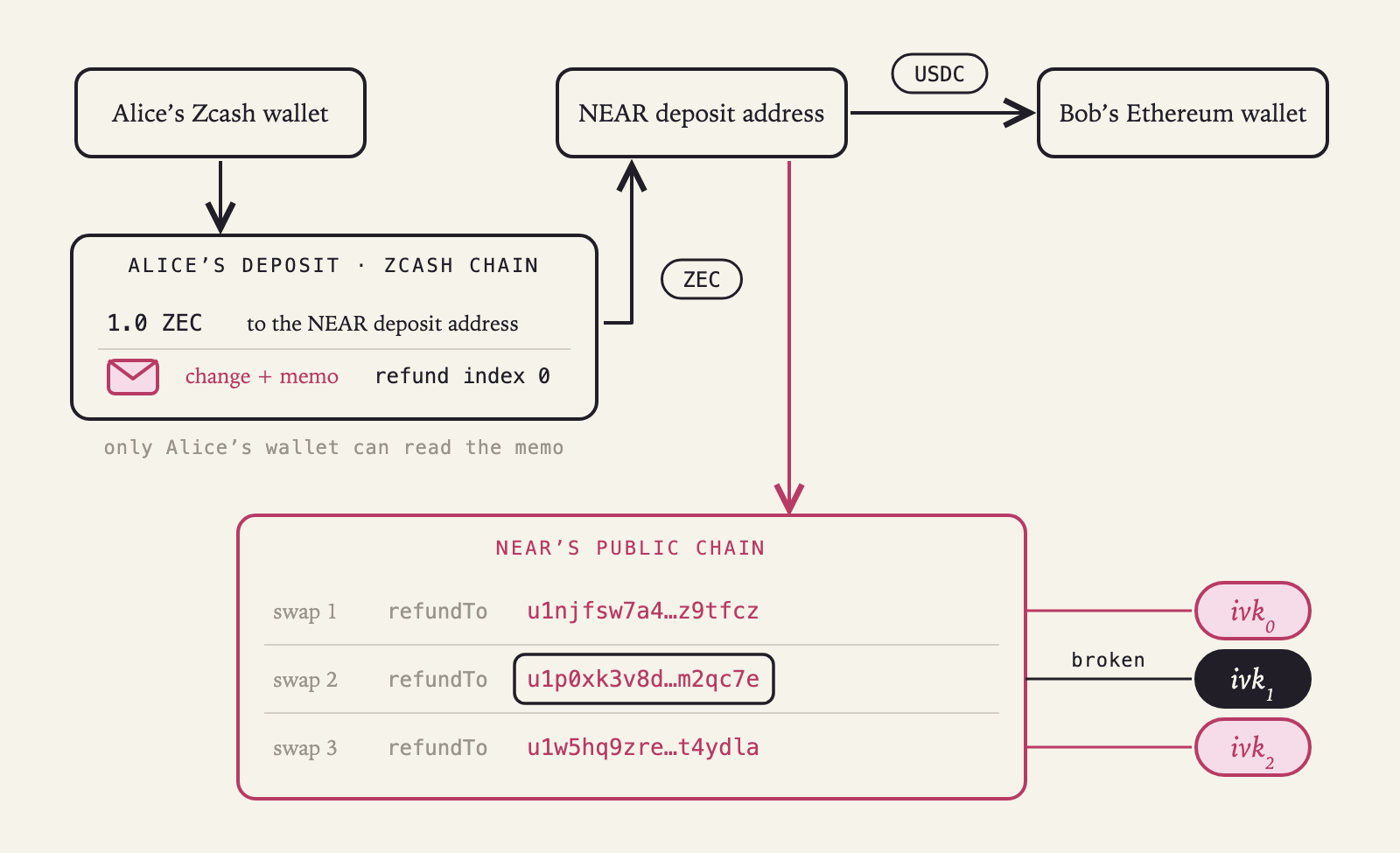
The swap fills and NEAR pays Bob his USDC. Any unused ZEC comes back to the refund address, and Alice spends it with her usual spending key. Every payment she makes this way takes the next index, with a new refund address, its own key and its own note to self.
On the day a sufficiently powerful quantum computer exists, an attacker can break one posted refund address and learn about that one refund. It doesn't tie that refund to Alice's other payments, or to her account.
Finding the Payments
Before this one-time idea, Alice’s wallet found all of her payments by trying her on every output on the chain in a process called trial decryption. Now, Alice has a key for every swap she has made. In everyday use this costs little, because her wallet only tries the keys of swaps that are still in flight, starting when each address is issued and retiring each one once its swap settles. Restoring from seed is different, since a fresh wallet would have to try every key Alice ever used against the whole chain, and that cost grows with every swap she makes.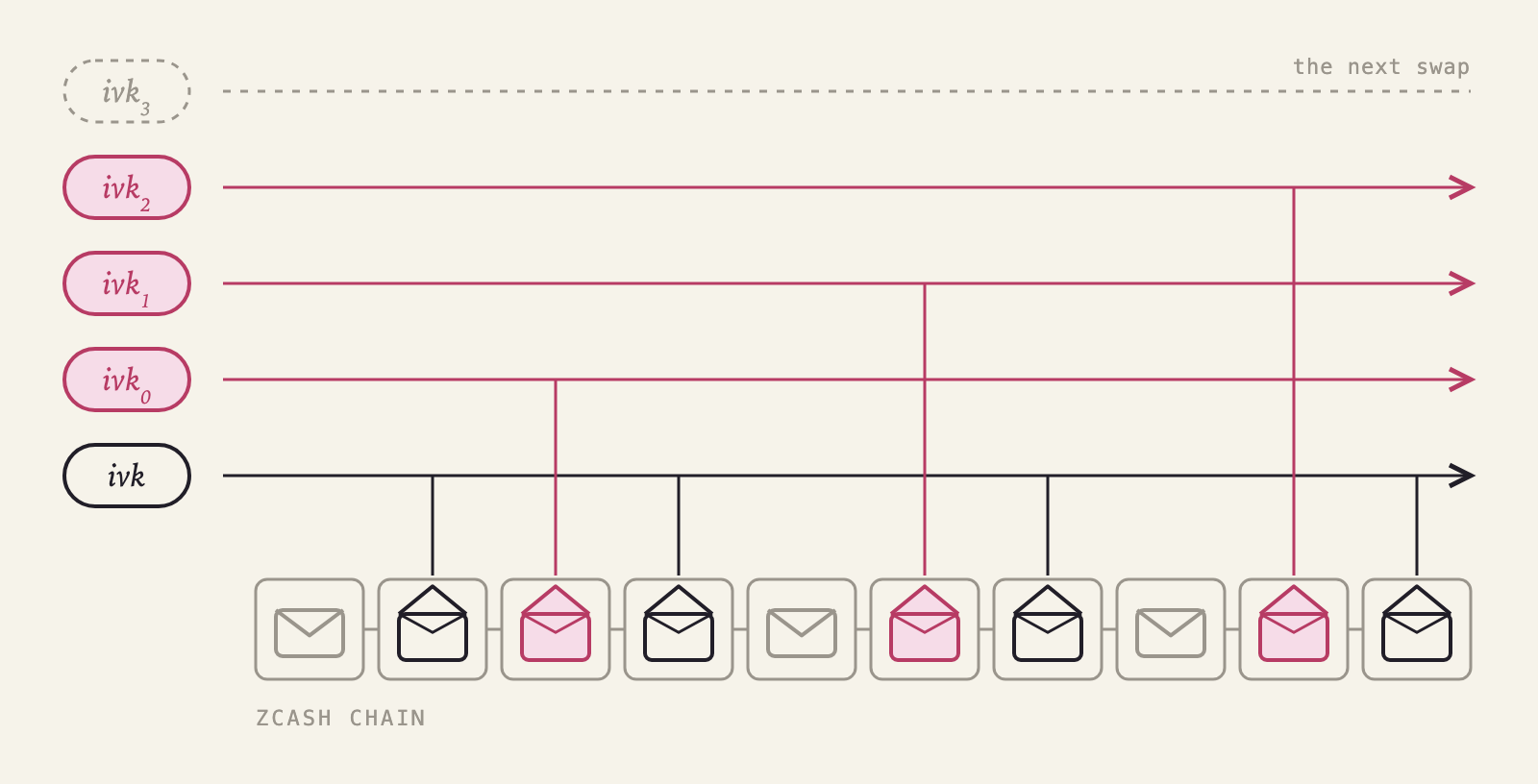
What if instead of scanning history with all of these keys, there existed some database we could query to not only determine if NEAR’s Zcash bridge sent funds to a given address, but also get pointed to the exact transaction?
Normally creating such a database in Zcash wouldn't be possible, but in the case of NEAR, every outgoing transaction from their bridge on Zcash is encrypted with the same all zero outgoing viewing key. This lets us scan the chain for all transactions that use this specific key and create an address to transaction database that we can query directly.
Instead of scanning history with many keys, a restoring wallet first checks its addresses against small filters, similar to Bloom filters, published alongside the database. Every wallet downloads the filters in full, so checking them reveals nothing about which addresses it holds. A filter can occasionally flag an address that was never paid, which only costs an extra lookup, but it never misses one that was. The wallet looks up only the addresses the filters say were paid, and each lookup points it to the exact transaction it must decrypt.
In order to prevent linking these addresses to the server hosting this database, the wallet asks with private information retrieval (PIR), the same lattice-based technique behind our private lookups for transparent wallets and Zcash voting. The wallet encrypts its question, the server computes the answer over every row of the database at once without being able to read what it is computing on, and only Alice can open the answer. The server never learns which address she asked about.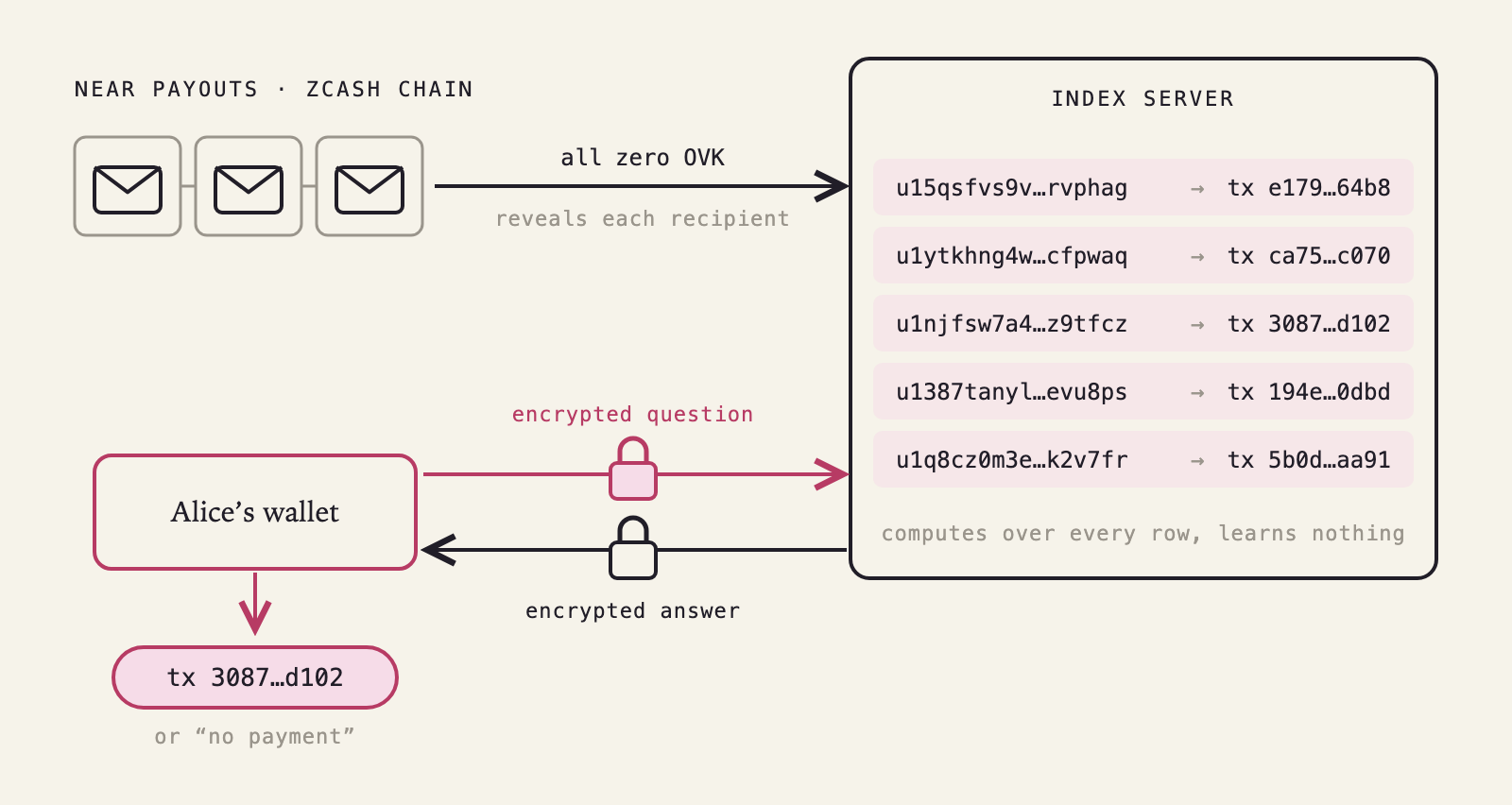
Restoring From Seed
Let's now discuss the steps to recover from mnemonic:
- The restored wallet runs its usual scan across all transactions with the account's viewing key. Among Alice's notes is the change from her NEAR deposit, with a note to self showing that index 0 was used to derive the for this specific swap.
- From index 0, the wallet re-derives the swap key and the refund address built on it, the same way it did for the deposit.
- If the published filter says that address was paid, the wallet looks it up privately and gets back the NEAR bridge transaction that paid it, without scanning the chain.
- The swap key decrypts that transaction.
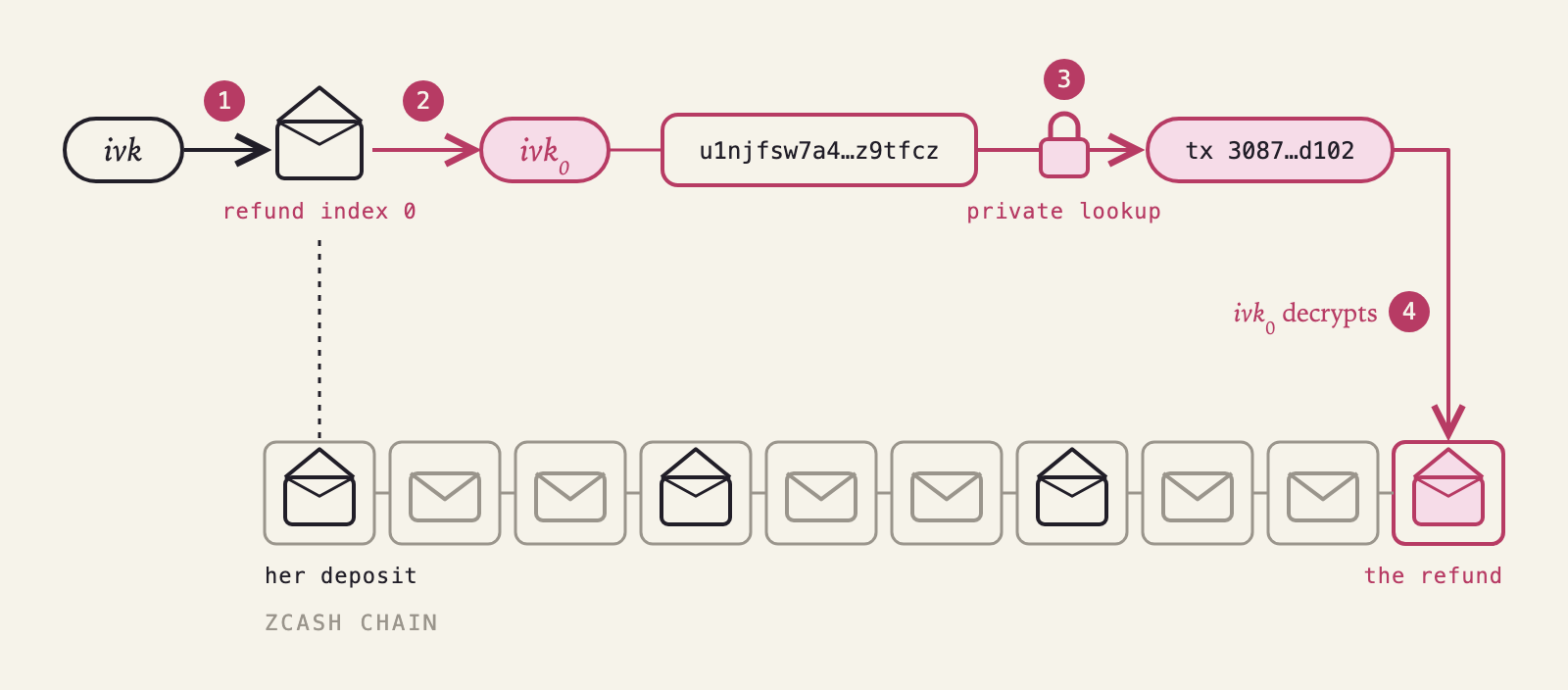
The wallet repeats this for every other note to self. Each note names one index, so the wallet rebuilds only the keys Alice actually used.
Swaps Into ZEC
There is one final NEAR swap case that needs to be handled, which is swaps from an external chain into ZEC. This needs a different approach, since Alice's Zcash wallet never sends anything on the Zcash chain itself, and is therefore not able to leave herself a change note which flags to her which index was used to generate the for that swap.
What Alice's wallet does in this case is derive a chunk of addresses, starting from index 0, and check them in order against the published filters, which list every Zcash address that was ever paid by NEAR, as well as every Zcash address NEAR has quoted but maybe not yet filled. Since her wallet used these addresses in order and the derivation is deterministic, she will find which of these addresses were paid via the filter, until she finds some continuous set of addresses that have gone unused.
Once, say, 30 addresses in a row are neither paid nor known to NEAR, the wallet knows it has found where the account left off. This is safe because the wallet never hands out an address more than 30 past the last one that was paid or given to NEAR. New swaps take the lowest address NEAR has never seen, so a quote Alice abandoned is never reused and two swaps never share an address.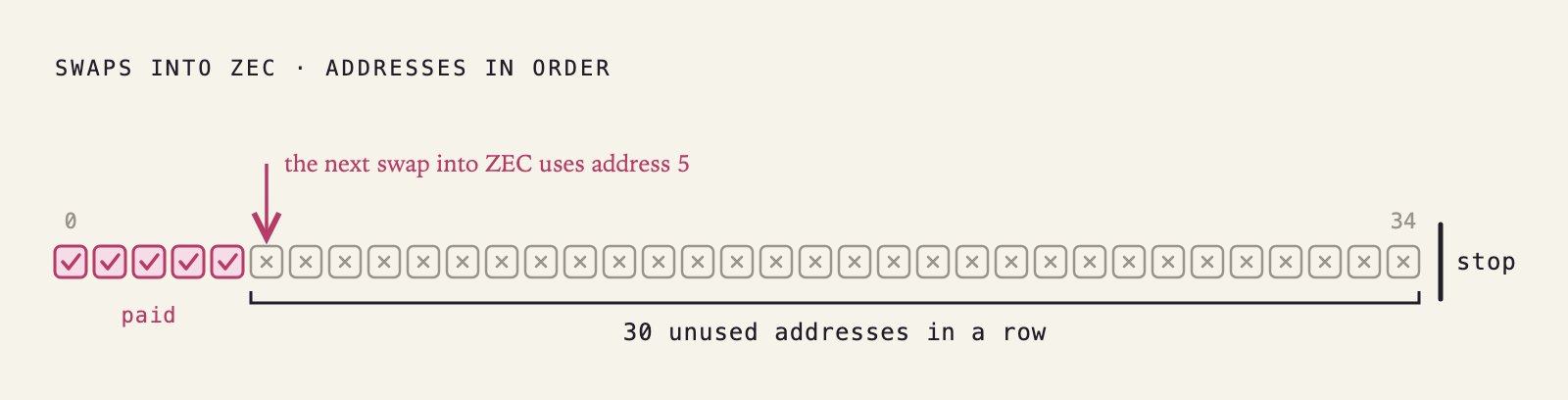
Next Steps
Wallets using Zakura’s open source cryptography and wallet libraries, such as Vizor, will be able to integrate this one-time feature for software wallets in the coming weeks. Hardware wallets will follow once their firmware supports it.